
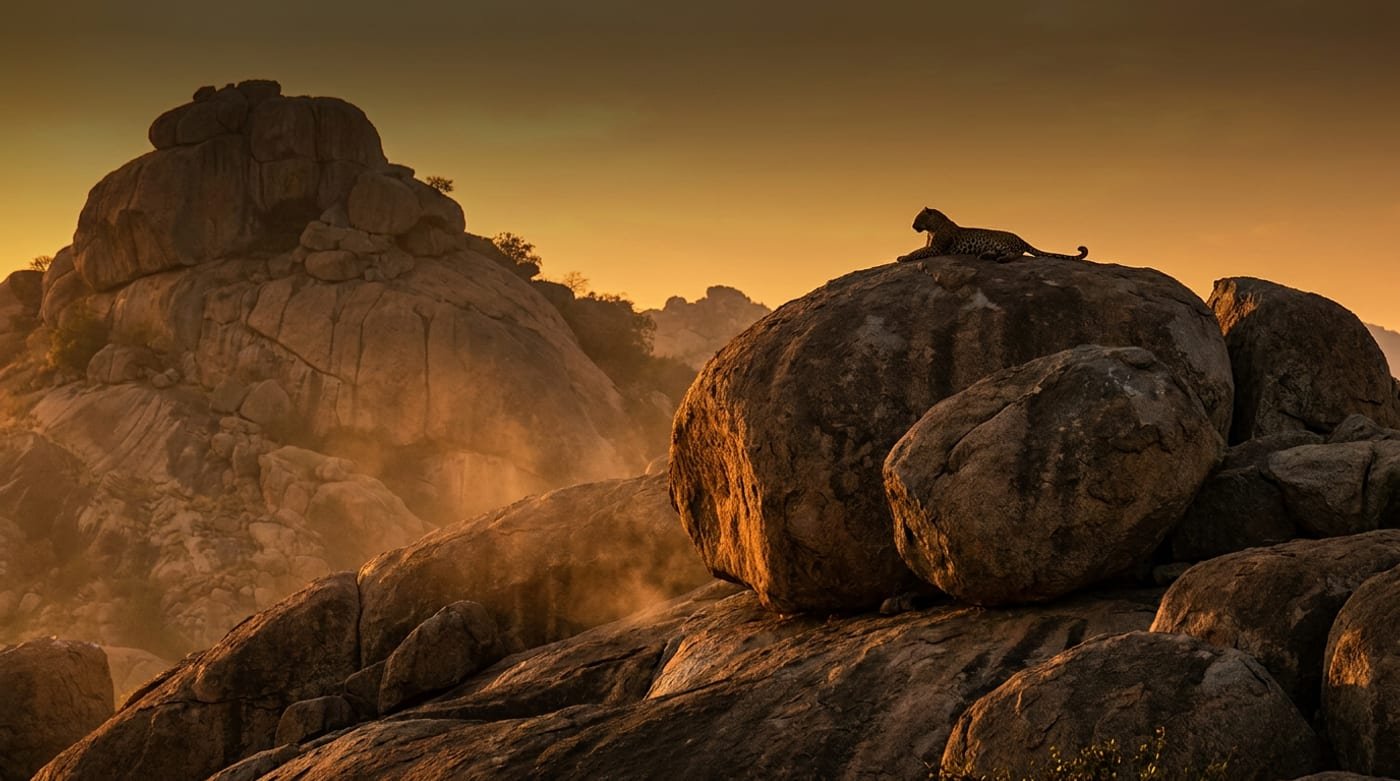
Tucked into the Aravalli foothills of Pali district, Rajasthan, Jawai (also written Jawai Bandh, and known to safari-goers as Bera) is one of the most remarkable wildlife destinations on earth. Here, wild Indian leopards live not deep inside a fenced national park but on open granite hills dotted with caves and hilltop temples — sharing the landscape with the Rabari shepherd community and their livestock in a famously peaceful coexistence.
A Jawai leopard safari takes you by open 4x4 gypsy across this dramatic terrain at dawn or dusk, when the big cats emerge to sun themselves on the rocks. This guide covers exactly where the safaris run, the timings and cost, the best season for sightings, what else you will see, and the top camps to book. For trip planning, also see our best time to visit Jawai guide.
What is the Jawai leopard safari?
Unlike a tiger reserve, Jawai has no ticketed park gate and no fixed core zone with watchtowers. Instead, leopards den in the rocky kopjes — rounded granite outcrops — that rise out of the plains around the Jawai dam. Safaris are run by local camps and operators in open gypsies, tracking leopards across the hills of Bera, Jawai Bandh and surrounding villages.
What makes it extraordinary is the relationship between predator and people. For generations the Rabari herders have lived alongside the leopards, which den near the hilltop shrines and rarely harm humans or livestock. The result is a uniquely intimate, story-rich safari rather than a queue of jeeps. Sightings are often at close quarters against a backdrop of granite, temples and grazing camels.
Where the safaris run — Bera & Jawai Bandh
The action centres on the Bera–Jawai Bandh wildlife area, a cluster of hills around the Jawai dam reservoir. Depending on your camp, drives spread across zones such as Bera, Kothar, Jeewada, Sena and Rughnathpura, each a network of farm tracks and rocky trails rather than a single road.
Because the leopards range over private farmland and village commons, your guide and tracker matter enormously — local knowledge of which hill a particular leopard favours is what turns a drive into a sighting. Beyond the cats, the same routes take in the Jawai dam, crocodile-basking spots and bird-rich wetlands.
Safari timings & cost
Safaris run twice daily, in the soft light of early morning and late afternoon, each lasting around three hours. Exact start times shift with the season — earlier in summer, a little later in winter — and most camps include tea, coffee and snacks on the drive.
Pricing is usually per private gypsy (seating up to six) and rises slightly in the peak October–March window. As a 2026 guide, expect roughly Rs 4,500–5,500 per gypsy per drive, with full-board camping packages billed per person per night. Confirm current rates and slot availability directly with your camp, as these change year to year.
Safari timings & season at a glance
| Season | Morning drive | Evening drive | Notes |
|---|---|---|---|
| Winter (Oct–Mar) | approx 6:00–9:00 AM | approx 4:00–7:00 PM | Peak season — best weather, reliable sightings |
| Summer (Apr–Jun) | approx 5:00–8:00 AM | approx 5:00–8:00 PM | Hot, but leopards stay near water — top for sightings |
| Monsoon (Jul–Sep) | approx 6:00–9:00 AM | approx 4:30–7:30 PM | Lush, green, fewer crowds, lower rates |
| Cost (guide, 2026) | Rs 4,500–5,500 / gypsy | per drive (up to 6 seats) | Higher Oct–Mar; confirm with camp |
Best time for leopard sightings
The best overall time is October to March, when cool, dry weather makes the open gypsy drives comfortable and the cats are active. The single best stretch for raw sighting odds, however, is the hot pre-monsoon months of April to June: as waterholes shrink, leopards concentrate near the dam and streams, and the bare hills make them easier to spot — you simply trade comfort for the heat.
Winter mornings can be genuinely cold in an open vehicle, so carry layers. Whatever the month, two to three drives over a couple of days dramatically improves your chances of a quality sighting.
What else you will see
Jawai is far more than its leopards. The Jawai dam and its reservoir host resident marsh crocodiles that bask along the banks, plus large flocks of migratory birds in winter — flamingos, bar-headed geese, cranes, pelicans and many waterfowl. Hyenas, jackals, desert foxes, nilgai and chinkara also share the terrain.
Cultural encounters are part of every drive: the turbaned Rabari herders, their camel and sheep caravans, and the small hilltop temples where leopards den just metres from worshippers. For a full list of sights see our places to visit in Jawai guide.
Top safari camps in Jawai
SUJÁN JAWAI
The pioneering luxury camp that put Jawai on the map — elegant tented suites, expert naturalists and arguably the finest guiding in the region.
Thar Jawai
A stylish boutique camp blending Rajasthani design with modern comfort, with its own naturalist team running tailored leopard drives.
Varawal Leopard Camp
A well-regarded mid-to-premium camp close to the prime Bera hills, known for strong tracking and personable hosts.
Thour Nature Resort
A comfortable resort-style base offering full safari packages and reliable access to the Jawai Bandh and Bera zones.
Jawai Leopard Camp
An intimate camp set on a private farm near Jawai Bandh, with a handful of tents and a focus on close, unhurried sightings.
How to plan & get there
Jawai sits roughly midway between Udaipur (about 150 km, 3 hours) and Jodhpur (about 160 km, 3 hours), the two nearest airports. The closest railhead is Jawai Bandh / Falna on the Ahmedabad–Jodhpur line. Most visitors drive in from Udaipur or pair Jawai with Kumbhalgarh and Ranakpur.
Plan a minimum of one full day (two drives) and ideally two nights for the best experience. Choose your camp for its location and guiding, then browse our roundup of the best resorts in Jawai to match your budget.
Frequently asked
Love Jawai? You could own a resort here — and earn from it.
Beyond visiting, Jawai is one of India's strongest branded-resort investment markets. Own a registered unit in a 5-star resort and earn 8–9% assured returns for five years, then a 50% share of net resort profit — with complimentary owner stays. ResortWealth is an independent advisor that compares projects across developers and brands, so you get the right one.