

If you have looked at resort property abroad — in Dubai, Florida, Bali, or Thailand — you have probably met the word "condo-hotel" (often shortened to "condotel"). It describes a simple idea: you own a specific, deeded unit inside a hotel or resort, a professional operator runs that unit as part of the hotel, and you earn a share of the income while keeping the right to use it yourself.
In India the same model exists — but it is usually sold under a different name: branded resort sale-leaseback. The vocabulary is foreign; the structure is local and, in the better projects, more investor-friendly than the classic overseas condotel. This guide explains what a condo-hotel actually is, how the Indian version works, what it really pays, the risks worth taking seriously, and the FEMA and tax rules that matter if you are an NRI.
What exactly is a condo-hotel?
A condo-hotel is a building that is legally part hotel, part individually-owned real estate. Instead of one company owning every room, individual investors own individual units — each with its own title — and a single hotel operator runs the whole property under one brand.
The crucial word is ownership. A condo-hotel is not a timeshare. In a timeshare you buy the right to use a property for a slice of time. In a condo-hotel you buy the unit itself — you get a registered deed, the asset sits on your balance sheet, you can sell it, gift it, or will it, and you keep any capital appreciation.
In return for letting the operator run your unit, you receive income. Abroad this is typically a variable share of a rental pool (you earn more in a good season, less in a weak one). In India, the dominant structure replaces that variability, for the first five years, with a contractual fixed rent — after which income becomes a 50% share of the resort's net profit — and that difference is what makes the Indian version worth understanding on its own terms.
How a condo-hotel works in India — step by step
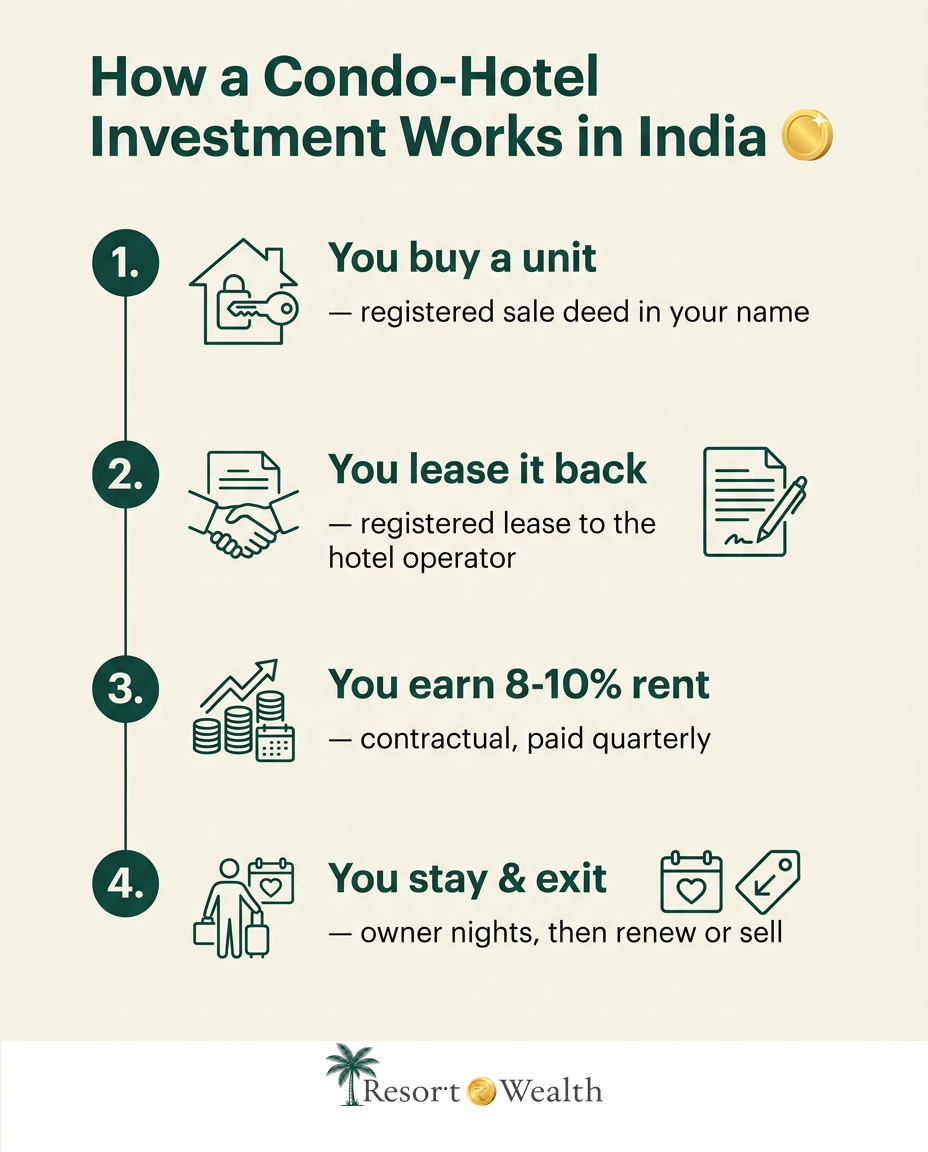
In India the model is structured as a registered sale-and-leaseback. There are four moving parts:
1. You buy a unit. You purchase a specific, identified unit — a room, suite, or villa — inside a branded resort (for example a Wyndham, Regenta, or Dolce property). The sale deed is registered at the sub-registrar in your name. This is genuine real estate ownership.
2. You lease it back. You sign a separately registered lease deed handing operations to the developer or hotel operator under a Sale-Leaseback agreement.
3. You earn contractual rent. For the first five years the operator pays you a fixed, location-based rent — typically 8–9% of the unit price, paid quarterly — regardless of how full the hotel is on any given night. From year six, income becomes a 50% share of the resort's net profit: variable, with no minimum, so if there is no profit there is no payout that year.
4. You use it and exit. Most structures include a number of complimentary owner stay-nights each year. Because you hold registered title in perpetuity, the lease never lapses on you — you exit whenever you choose by selling the unit on the secondary market.
Condo-hotel vs timeshare vs fractional vs whole property
| Feature | Condo-Hotel (Condotel) | Timeshare | Fractional / SM REIT | Whole Property |
|---|---|---|---|---|
| What you own | A whole, deeded unit | Right to use (weeks) | A share of one asset | The entire asset |
| Registered title | Yes — sale deed | No | Via SPV / units | Yes |
| Income | 8–9% fixed for 5 yrs, then 50% net-profit share | None (you pay fees) | Variable, pooled | Variable rent |
| Who manages it | Hotel operator | Resort | Platform / manager | You |
| Personal use | Owner stay-nights | Your booked weeks | Usually none | Unlimited |
| Entry ticket | ₹40L – ₹4 Cr+ | ₹2L – ₹25L | ₹10L+ (SM REIT) | Full price |
How much does a condo-hotel actually pay? A real ₹50 lakh example
Numbers make this concrete. Take a studio unit in a branded resort priced at ₹50 lakh, on a contractual 9% lease for the first five years:
Annual rent (years 1–5): ₹4.5 lakh (₹50L × 9%), paid as roughly ₹1.12 lakh per quarter.
Monthly equivalent: about ₹37,500 — landing in your account whether or not your specific unit was occupied, for each of the five assured years.
Five-year total: ₹22.5 lakh of assured rent. From year six, income becomes a 50% share of the resort's net profit — variable, with no floor — so do not project the 9% beyond year five; model the later years as an equity-style profit share.
Owner stays: typically 15–25 complimentary nights a year across the operator's portfolio, worth ₹1.5–3 lakh in retail value.
Capital appreciation: branded hotel real estate in strong locations has historically appreciated 5–8% a year — real, but not contractual, so treat it as upside rather than a promise.
Compare that 9% contractual yield over the assured years with a fixed deposit at ~7% (fully taxed, no asset) or a typical residential rental yield of 2–3.5% in Indian metros, and the appeal becomes clear — provided the structure is sound. That last clause is the whole game. If you are weighing a holiday home, see how to buy a vacation home in India.
Are condo-hotels a bad investment? An honest answer
Search "condo-hotel" abroad and you will find sceptical articles warning you off. They are not wrong — they are describing the classic overseas rental-pool condotel, which has real, repeated problems. It is worth taking each one seriously and asking whether the Indian sale-leaseback structure actually answers it.
"The income is unpredictable." True for a rental-pool condotel. The Indian sale-leaseback replaces the pool with a fixed contractual rent for the first five years, so your income does not swing with occupancy in that period. (The risk shifts to the operator's ability to pay — see below.) Be clear-eyed about what follows: from year six income becomes a 50% share of the resort's net profit, which is variable and has no minimum — the fixed rent is a five-year covenant, not a lifetime one.
"Management fees eat the returns." In a rental-pool model, owners often surrender 30–50% of revenue in fees. In the fixed-rent years of a leaseback, the percentage you are quoted is your net rent — operating costs are the operator's problem, not a line item deducted from you. In the profit-share years, operating costs are deducted before your 50% is calculated, so ask how "net profit" is defined in the lease.
"Financing is hard and resale is illiquid." True on financing: these units are not eligible for a standard home loan — banks treat them as commercial hospitality assets — so you buy outright or via a staged developer payment plan. Secondary-market liquidity is also slower than residential, so plan a 5+ year hold.
"You depend entirely on the operator." This is the one genuine, irreducible risk, and no structure removes it. A fixed rent from a weak operator is not really fixed. This is exactly why the brand, the operator's balance sheet, a parent guarantee, and an escrow arrangement matter more than the headline yield.
So: a poorly structured condo-hotel is a bad investment. A registered, RERA-compliant, branded sale-leaseback with a credible operator is a different animal. The label is the same; the engineering is not.
Why is the Indian condo-hotel structure often stronger?
Two registered documents, both in your name. A registered sale deed plus a separately registered lease deed give you far more legal standing than the single purchase agreement common in overseas condotels.
RERA oversight. Genuine projects are registered with the state RERA authority, with each unit accounted for. You can verify the RERA number directly on the state portal before you commit.
Contractual first, then profit-linked. Your return for the first five years is written into a lease, not derived from a hotel's monthly performance — a fundamentally more predictable cash flow. Thereafter you hold a 50% share of net resort profit; the mechanics of that share should also be written into the registered lease, even though the amount is not fixed.
None of this removes the need for diligence. It simply means the better Indian projects start from a stronger legal base than the condotel horror stories you will read about from other markets. A quick reality check on any "assured" or "guaranteed" wording is also wise — in India, income should be presented as a contractual registered lease, never as a guaranteed scheme. (Confirm specifics with your own advisor.)
Condo-hotels and NRIs — the FEMA and tax bit
For NRIs and OCIs this is one of the most accessible ways to hold Indian real estate, because the rules are clear.
You are allowed. Under FEMA, NRIs and OCIs can freely buy residential and commercial property in India — a branded resort unit qualifies. The only off-limits categories are agricultural land, farmhouses, and plantations. No RBI approval is needed for an eligible purchase.
Payment. Funds must flow through normal banking channels in INR — typically from your NRE or NRO account. No cash, no foreign-currency settlement.
Tax. Rental income is taxable in India as house-property income; double taxation is generally relieved through the relevant tax treaty (DTAA). On sale, TDS applies. These are manageable, but the specifics decide what you actually keep — so confirm them with a qualified CA.
Repatriation. Rent and sale proceeds are repatriable within FEMA limits (broadly up to USD 1 million per financial year from an NRO account, subject to Forms 15CA/15CB).
This is general information, not tax advice. The tax structure — not just the headline yield — is what decides an NRI's real return, so it is worth getting right before you sign.
Bottom line
A condo-hotel is a real, ownership-based way to earn income from branded hospitality without running anything yourself. The overseas version earns its sceptics; the Indian sale-leaseback version answers most of their objections by swapping a variable rental pool for a registered lease with five years of fixed rent (then a 50% share of net resort profit) — while leaving one risk that no structure can remove: the operator must be good for the money.
So the question is never "are condo-hotels good or bad?" It is "is this project — this operator, this lease, this RERA registration, this title — sound for my goals?" That is the question an independent advisor exists to answer, before you commit a rupee.
Frequently asked
Ready to invest?
Free advisor consultation — get a personalised investment report with current property availability, RERA documents, and unit-level projections.
💬 Free Consultation