

If you want a holiday property to earn its keep, two models dominate the conversation: a managed vacation rental (think a villa or apartment let out short-term, Airbnb-style, run by a management company) and a branded resort sale-leaseback (a unit inside a 5-star resort, leased to the operator for a fixed rent in the early years and a profit share after that).
On the surface they sound similar — own a property, let someone else run it, collect income. But they split the most important variable, risk, in opposite directions. Understanding that one difference tells you which model actually fits you.
What is a managed vacation rental?
You buy (or already own) a villa, apartment, or cottage in a leisure destination and hand it to a vacation-rental management company. They market it, handle bookings, guest check-in, cleaning, and maintenance — for a fee. You keep what is left after their cut and the running costs.
The upside: in a strong season with high occupancy, your income can be excellent, and you can usually block dates for personal use whenever you like. The catch: your income is variable. Empty weeks, seasonality, platform fees, furnishing, repairs, and a slow month all land on you. You own the property and you own the risk.
What is a branded sale-leaseback?
You buy a registered unit inside a branded resort (Wyndham, Regenta, Dolce and similar) and sign a registered long-term lease handing operations to the hotel operator under a Sale-Leaseback agreement. In return you receive a fixed, location-based assured return — typically 8–9% of the unit price a year — for the first five years, paid regardless of occupancy; from year six income becomes a 50% share of the resort's net profit, variable with no minimum, plus a set number of owner stay-nights. (See our hotel room investment and condo-hotel guides for the full structure.)
The upside: predictable, hands-off income and a globally branded operator filling the rooms. The trade-off: for the first five years a blockbuster season does not lift your rent (it is fixed), and from year six your income rides on resort profit with no floor; liquidity is lower, and your income depends on the operator staying financially sound. You own the asset; for the assured years the operator owns the occupancy risk, after which you share it.
Head to head
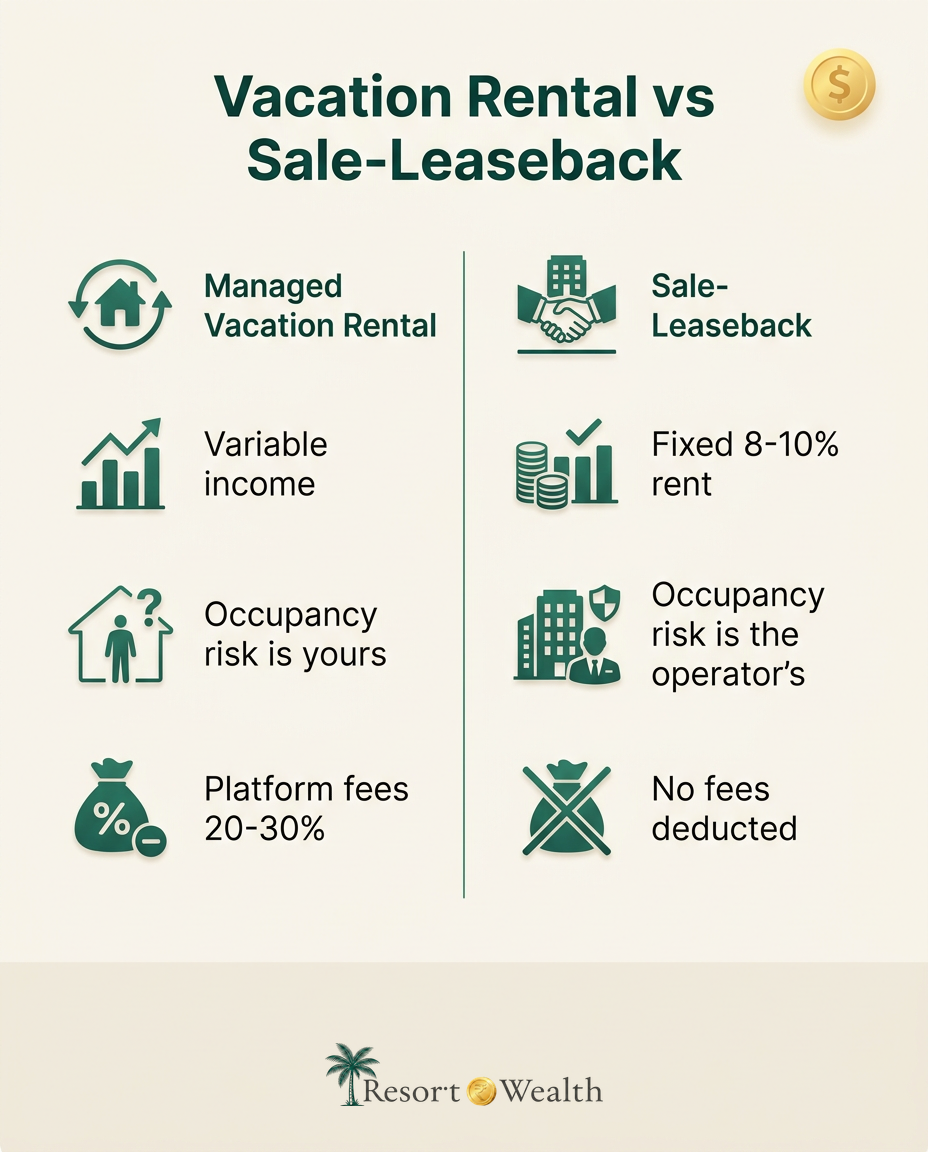
| Factor | Managed Vacation Rental | Branded Sale-Leaseback |
|---|---|---|
| Income | Variable, occupancy-linked | Fixed 8–9% for 5 yrs, then 50% of net profit |
| Who carries occupancy risk | You | The operator (yrs 1–5); shared via profit after |
| Fees | Mgmt + platform (20–30%+) | None deducted (rent is net) |
| Furnishing & repairs | Your cost | Operator's cost |
| Brand & demand engine | Listing platforms | Global hotel brand |
| Personal use | Flexible, block any dates | Set owner stay-nights |
| Best season upside | Yours to keep | Capped in yrs 1–5; 50% via profit share after |
| Predictability | Low | High for 5 yrs, then profit-linked |
The core trade-off, in one line
A managed vacation rental gives you higher potential income and more flexibility, in exchange for carrying the risk yourself. A branded sale-leaseback gives you predictable income for the first five years and zero operational work, in exchange for capping your upside in those years, accepting a profit-linked (no-floor) share afterwards, and lower liquidity.
Neither is "better." They are two different bets: one on your ability (and appetite) to ride occupancy swings, the other on a credible operator paying a contracted rent.
The numbers, honestly
Take a ₹1 crore property. A well-run managed vacation rental in a strong location might gross 10–12% but, after the management cut, platform fees, furnishing amortisation, utilities, and the inevitable empty weeks, net yields often land in the 4–7% band — with real volatility year to year.
A branded sale-leaseback on the same ₹1 crore pays a contractual 8–9% for the first five years net of operating costs (those are the operator's problem), with no furnishing or repair bills; from year six it pays a 50% share of net resort profit instead, with no floor. The headline looks higher and the variance is far lower in the assured years — but you cannot capture a bumper season then, the later profit share is genuinely variable, and exiting takes longer.
The break-even, roughly: to match the 8–9% a sale-leaseback pays automatically in its five assured years, a managed vacation rental typically has to sustain around 60–70% occupancy all year at healthy nightly rates — after management fees, platform commissions and running costs. Many Indian leisure markets average nearer 40–60% once the off-season is counted, which is why the "fixed vs variable" gap is usually wider in practice than the headline yields suggest.
A quick honesty note: be wary of any vacation-rental pitch quoting only peak-season occupancy, or any leaseback described as a "guaranteed scheme." Genuine resort income is a contractual registered lease, not a guarantee — verify the operator and the documents. (Confirm specifics with your own advisor.)
Which one fits you?
Choose a managed vacation rental if you want maximum flexibility for personal use, you are comfortable with variable income, you will stay involved (even lightly), and you believe in your specific location's demand.
Choose a branded sale-leaseback if you want truly passive, predictable income, you prefer a global operator carrying the occupancy risk in the assured years, you are comfortable that income becomes a 50% share of net resort profit (no floor) from year six, and you can hold for 7–10 years. NRIs often prefer this route — it is genuinely hands-off across time zones and FEMA-friendly.
Some investors do both: a leaseback for the predictable income sleeve, a vacation rental for the flexible, higher-variance sleeve. The right mix follows your goals, not a sales pitch. See also: how to earn passive rental income from a resort or vacation property and is a resort or vacation home a good investment?
Bottom line
Managed vacation rentals and branded sale-leasebacks answer the same wish — income from a holiday property without running it — in opposite ways. One hands you the upside and the risk; the other hands you predictability and a credible counterparty. Pick the one whose trade-off you actually want to live with.
If predictable, hands-off income from a registered, branded asset sounds like your kind of bet, the next step is to verify a specific project, lease, and operator before committing — which is exactly what an independent advisor is for.
Frequently asked
Ready to invest?
Free advisor consultation — get a personalised investment report with current property availability, RERA documents, and unit-level projections.
💬 Free Consultation