
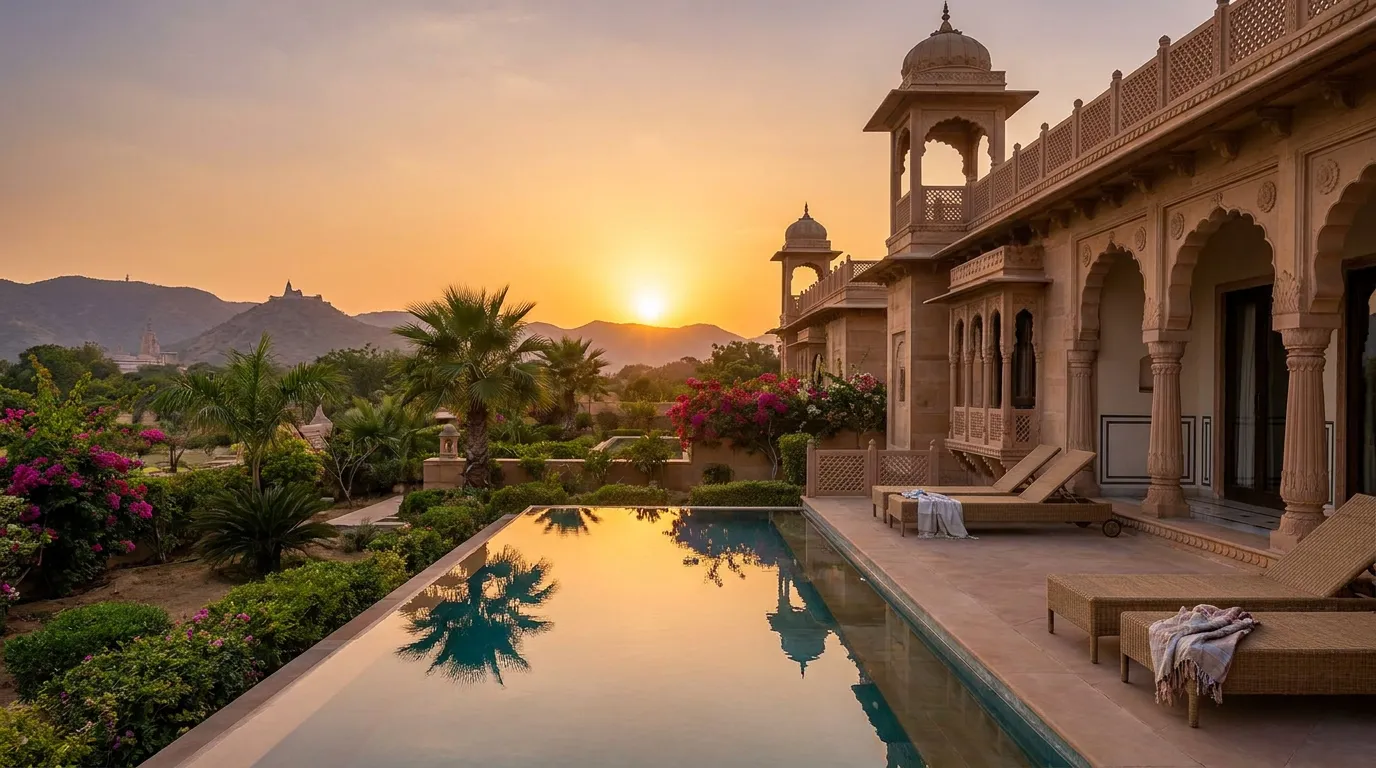
Clarks Resort Pushkar is a genuine branded-resort investment, not a scheme: you buy a registered unit inside a 5-star resort, earn a contractual 8% annual return for the first 5 years, then move to a 50% revenue-share partnership, with an assured buyback option and possession targeted for December 2027. From roughly ₹65 lakh it is credibly priced and carries a marquee operator — but it is a pre-completion project by a first-time hospitality developer, and the income turns variable after year five. Both facts matter before you commit.
This is an independent review, not the developer's brochure. ResortWealth is an advisor that resells branded resort investments across several operators — including Clarks Pushkar and the competing Regenta Resort & Spa Pushkar in the same town — so we have no reason to oversell one over the other. The goal here is the honest answer a ₹60-lakh-plus buyer actually needs: what it pays, what can go wrong, and who it genuinely suits.
What exactly is Clarks Resort Pushkar?
Clarks Resort Pushkar is a new, roughly 175-key branded resort coming up on Sawai Pura Road in the Suraj Kund area of Pushkar, Rajasthan. It is developed by the Dreamline Group of Jaipur and operated under the Clarks brand. You purchase a registered unit — from a Superior Room up to a Presidential Suite villa — and the operator runs it as part of the hotel and shares the income with you.
The operator pedigree is the headline strength. Clarks is one of India's oldest hotel names, founded in 1947, and in August 2025 the Tata Group's Indian Hotels Company (IHCL) — the parent of Taj — agreed to acquire a 51% majority stake in the companies that run the Clarks network. That puts Tata-group institutional backing behind the brand running the resort, which is a rare level of operator credibility for an assured-return resort in a small town.
Units start from roughly ₹65 lakh (Superior Room) and rise to about ₹2.55 crore for a Presidential Suite villa, with possession targeted for December 2027. Owners also receive complimentary stay-night vouchers each year, food-and-beverage and spa discounts, and a one-time large-event benefit.
Key takeaways
- Structure: 8% assured return for 5 years, then a 50% revenue-share partnership — fixed income first, variable income later.
- Operator: Clarks (founded 1947); Tata's IHCL agreed in 2025 to take a 51% stake in its operating companies — strong hospitality credibility, with a brand question to settle (see FAQ).
- Developer: Dreamline Group, Jaipur — this is their first hospitality project, so documentation diligence matters more, not less.
- Entry: ~₹65 lakh to ₹2.55 crore; possession December 2027 (a pre-completion buy).
- Exit: an assured buyback option is offered — confirm the price and date in the registered agreement.
- Watch-outs: pre-launch timeline, a first-time developer, and variable income after year 5.
Is Clarks Resort Pushkar the same as Clarks Safari Pushkar?
No — these are two different properties, and confusing them is the most common mistake buyers make. Clarks Safari Pushkar is an existing, already-operating hotel in Pushkar (run by a separate hospitality company and reviewed on TripAdvisor and the OTAs). Clarks Resort Pushkar is a brand-new investment resort that is still under construction, with possession targeted for December 2027.
This matters for two reasons. First, when you read reviews or ratings for "Clarks Pushkar" online, check which property they describe — the operational Safari hotel's guest reviews say nothing about the new resort's investment terms. Second, during due diligence, confirm the exact legal name, address and RERA registration number of the unit you are buying, so there is no ambiguity about which project your money is going into.
What returns does Clarks Pushkar actually pay?
The return comes in two phases. For the first five years you receive a contractual 8% assured annual return on your investment — a fixed number written into the agreement, paid regardless of how full the hotel is. On a ₹65-lakh unit that is about ₹5.2 lakh a year.
After year five, the structure converts to a 50% revenue-share partnership — you receive half of the profit the resort generates from rooms, dining, spa, events and weddings. This phase is genuinely variable: it can pay more than 8% in strong years and less in weak ones, because it tracks actual occupancy and room rates rather than a fixed covenant. If you value certainty, treat only the first five years as predictable and the rest as upside.
That hybrid is different from a classic sale-leaseback, where a fixed rent is contracted under a Sale-Leaseback agreement. We break down the trade-off in sale-leaseback vs revenue-sharing — worth reading before you sign, because the two models suit very different temperaments.
Clarks Pushkar vs Regenta Pushkar vs a bank FD
| Factor | Clarks Resort Pushkar | Regenta Resort & Spa Pushkar | Bank FD |
|---|---|---|---|
| Entry price | ~₹65 L | ~₹75 L | Any amount |
| Return | 8% assured (5 yrs), then 50% revenue-share | 8% assured, long-term lease | ~6.75–7% |
| Income type | Fixed then variable | Fixed throughout | Fixed |
| Operator | Clarks (Tata / IHCL-backed) | Regenta by Royal Orchid | Bank |
| Possession | Dec 2027 | 2026 | Immediate |
| Free stay nights / yr | 14 | 25 | None |
| Own a registered asset | Yes | Yes | No |
| Liquidity | Low (5+ yr hold) | Low (5+ yr hold) | High |
What are the risks of investing in Clarks Pushkar?
This is the section the official site will not write — so read it carefully. None of these are deal-breakers on their own, but together they define what you are underwriting.
1. It is a pre-completion project. Possession is targeted for December 2027, which means construction and delay risk, and your income only begins once the resort is operational. Confirm the payment-linked plan and whether the 8% accrues before or only after possession.
2. It is the developer's first hospitality project. Clarks is a seasoned operator, but the real-estate developer (Dreamline Group) is new to hotels. The brand runs the resort; the developer builds and delivers it — so verify the developer's balance sheet, the escrow mechanism, and who legally signs the assured-return covenant.
3. The assured 8% is only as strong as the entity paying it. "Assured" means contractual, not government-guaranteed. Check exactly which company signs the return obligation, and what backs it if occupancy is low in the early years.
4. Income turns variable after year 5. The 50% revenue-share can exceed 8% — or fall below it — depending on how the resort performs. Do not assume 8%-forever.
5. It is illiquid. A resort unit is far slower to sell than a mutual fund or an FD; plan a five-year-plus hold. The buyback option helps, but only if its price and date are written into the registered agreement.
A disciplined buyer checks all of this before paying a rupee. Our how to verify a resort investment guide is the exact checklist — RERA registration, registered sale and lease deeds, the paying entity, and the escrow structure.
Who should consider Clarks Pushkar — and who should not?
A good fit: an income-focused buyer with ₹65 lakh–₹1 crore who wants a branded, registered asset run by a marquee operator, values the Tata/IHCL pedigree, can hold for five years or more, and is comfortable owning a pre-completion project that delivers in 2027.
A buy-to-use pilgrim or Rajasthan-lover also fits well — you get complimentary owner stay-nights at a 5-star resort in one of India's holiest towns, while the operator earns you income the rest of the year.
NRIs and OCIs fit the hands-off model: a registered Indian hard asset earning rupee income with no management from abroad. Confirm FEMA routing and TDS with a CA before you commit.
A poorer fit: anyone who needs the money back within two to three years, cannot tolerate a pre-completion timeline, or wants a fixed income for the full term. If certainty is your priority, the classic Sale-Leaseback agreement at Regenta Pushkar — which also delivers a year earlier — may suit you better than Clarks' fixed-then-variable structure.
Clarks vs Regenta in Pushkar — which is the better investment?
It depends on which you value more: upside and operator prestige, or predictability and an earlier start. Both are registered branded-resort investments in the same high-footfall pilgrimage town, so the location case is similar. The difference is the structure.
Choose Clarks Pushkar if you want the lower entry price (~₹65 lakh), the Tata/IHCL-backed Clarks operator, and are happy to trade some certainty for revenue-share upside after year five. Choose Regenta Pushkar (now sold out) if you want a classic 8% fixed return locked under a Sale-Leaseback agreement, an earlier possession (2026), and a proven, straightforward format — at a slightly higher entry (~₹75 lakh).
Neither is universally "better". The right pick is the one whose structure matches your temperament — which is exactly the kind of side-by-side an independent advisor can walk you through, and the developer's own site cannot.
Bottom line — is Clarks Pushkar worth it?
Clarks Resort Pushkar is a credible opportunity, not a red flag. You get a real, registered asset, a genuinely strong operator now backed by the Tata Group, an attractive entry price, and useful lifestyle perks in a destination with dependable year-round footfall. The honest caveats are the 2027 pre-completion timeline, a developer taking on its first hotel, and income that becomes variable after the first five years.
If the registered lease, the buyback price and date, the RERA registration, and the entity paying the assured return all check out under scrutiny, Clarks Pushkar earns a place on an income-focused shortlist — reviewed side by side with Regenta Pushkar rather than in isolation. Verify first, compare honestly, then decide. That is the difference between buying a brochure and buying an asset.
Want the registered documents, the current confirmed price list and a straight Clarks-vs-Regenta comparison for your budget? Message a ResortWealth advisor on WhatsApp — independent, no obligation.
Frequently asked questions
Ready to invest?
Free advisor consultation — get a personalised investment report with current property availability, RERA documents, and unit-level projections.
💬 Free Consultation