
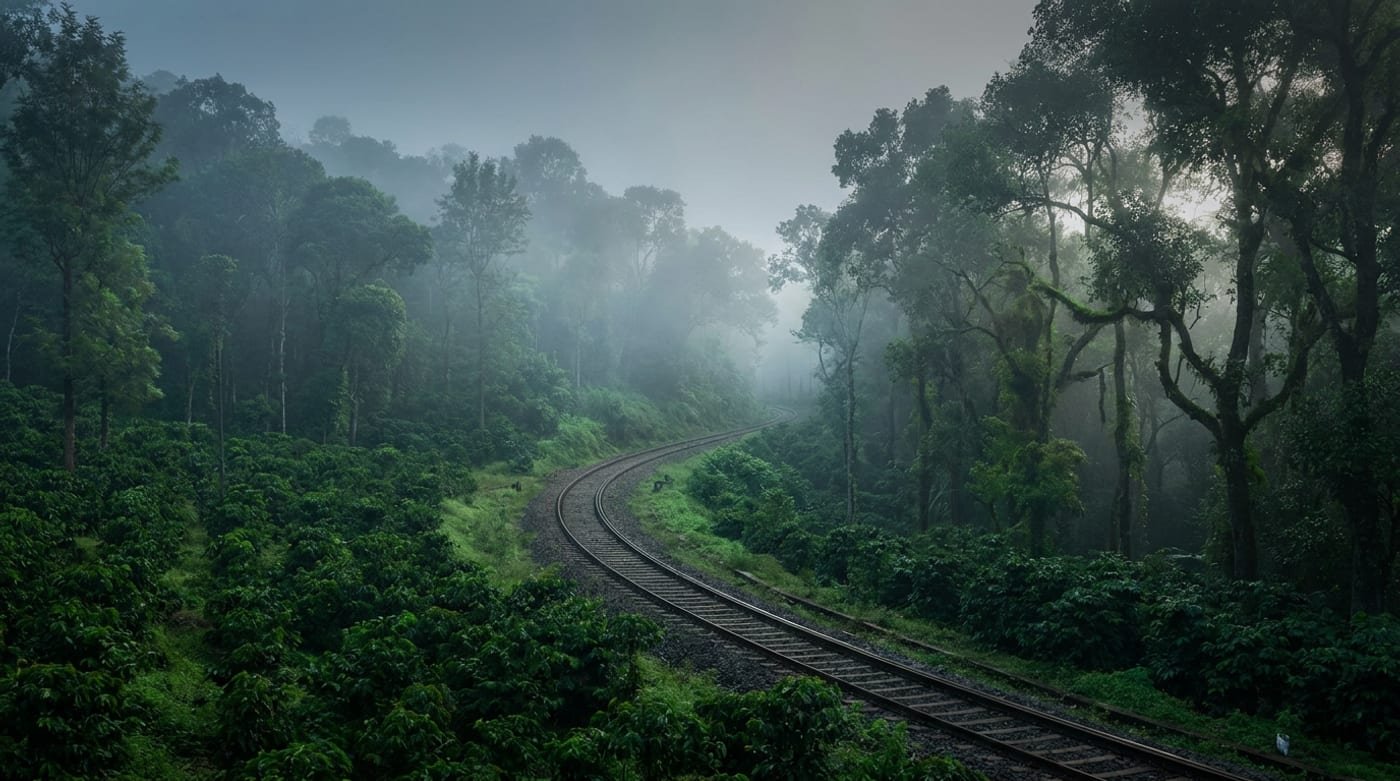
Mookanana Falls is one of the most rewarding hidden waterfalls in the Sakleshpur area — a beautiful cascade reached only after a moderate forest trek of a few kilometres. Unlike the roadside falls of the region, getting here takes a little effort, which keeps the crowds away and makes the arrival all the more satisfying.
The waterfall tumbles down a rocky face into a pool ringed by dense Western Ghats greenery, and is at its most powerful during and just after the monsoon. This guide covers the falls, the trek, the best time to visit, how to reach it and what to carry. For the wider picture, see our places to visit in Sakleshpur and things to do in Sakleshpur guides.
The waterfall
Mookanana Falls drops in a single ribbon down a steep rock face, fed by streams running off the surrounding hills. At the base it collects in a natural pool framed by ferns, boulders and thick forest — a quiet, photogenic spot that feels a world away from the nearest road.
In the post-monsoon months the flow is strong and the green is at its most vivid. The pool is shallow in places, but the rocks are slippery and the current can be deceptive when the flow is high, so caution is essential and the falls are best enjoyed from the edge rather than under the cascade.
The trek
Reaching Mookanana Falls involves a moderate trek of roughly a few kilometres each way through forest and plantation land, taking around one to two hours depending on the trail and the conditions. The path crosses streams, climbs over roots and rocks, and can be muddy and slippery, especially in and after the rains.
Because the route is not always clearly marked and passes through forest, it is strongly recommended to go with a local guide. A guide keeps you on the right trail, helps at the trickier stream crossings and knows the safest spots near the falls.
Best time to visit
Mookanana Falls is at its most spectacular just after the monsoon, roughly September to December, when the cascade is full and the forest is lush but the trail is no longer at its most dangerous. This is the sweet spot for both the volume of water and a manageable trek.
During the heaviest monsoon (June to August) the falls are thunderous but the trail is very slippery and stream crossings can be risky. By the dry pre-summer months (March to May) the flow thins out considerably. See our best time to visit Sakleshpur guide for the seasonal overview.
Quick facts
| Detail | Information |
|---|---|
| Best time to visit | Post-monsoon (September–December) |
| How to reach | Drive from Sakleshpur, then trek a few km to the falls |
| Difficulty | Moderate — forest trek with stream crossings, 1–2 hrs each way |
| Guide | Recommended; trail is unmarked in places |
| What to carry | Water, snacks, grippy shoes, a change of clothes |
| Safety | Slippery rocks; stay clear of the strong current |
What to carry and trek tips
Wear sturdy shoes with good grip, as the trail and the rocks near the falls are slippery. Carry plenty of water, some snacks and a change of clothes, since there are no shops along the way. Leeches are common in the wet season, so socks and a little salt or anti-leech spray help.
Start early so you finish the trek and the return walk well before dark, and carry out all your litter — this is unspoilt forest. Avoid attempting the trek alone or after heavy rain, when streams can rise quickly.
What to see nearby
Mookanana Falls fits well into a wider Sakleshpur trip. Pair it on separate days with the star-shaped Manjarabad Fort, the sweeping Bisle Ghat viewpoint, or a walk through a working coffee and cardamom estate.
Keen trekkers can add other classic hikes such as Agni Gudda or the Green Route railway walk. See our places to visit in Sakleshpur guide to plan a full itinerary.
Frequently asked
Love Sakleshpur? You could own a resort here — and earn from it.
Beyond visiting, Sakleshpur is one of India's strongest branded-resort investment markets. Own a registered unit in a 5-star resort and earn 8–10% assured annual returns — with complimentary owner stays. ResortWealth is an independent advisor that compares projects across developers and brands, so you get the right one.