
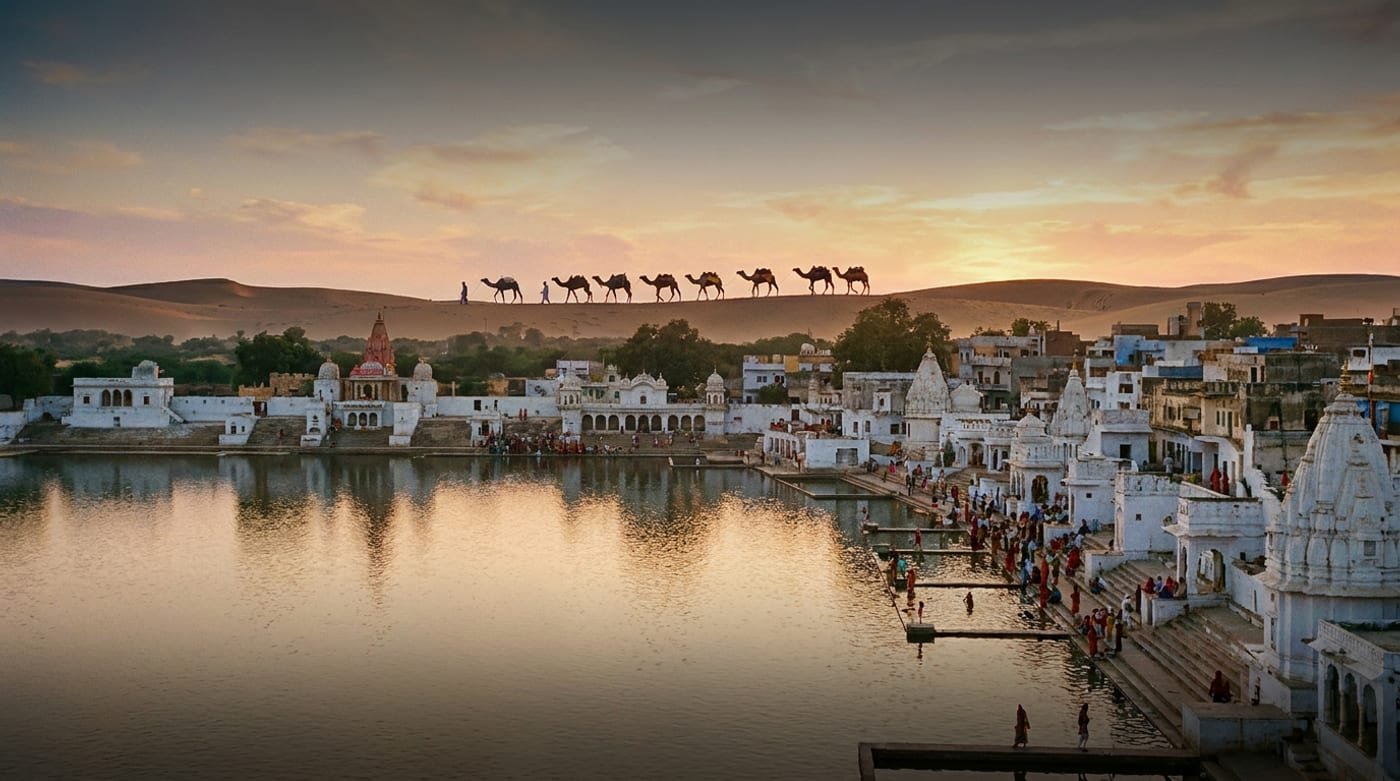
Pushkar Lake is the sacred core of the town and one of the five holiest pilgrimage waters in Hinduism. According to legend the lake formed where a lotus fell from Lord Brahma's hand, and pilgrims have bathed at its edge for centuries in the belief that a dip here washes away sins. Whatever your faith, the ring of whitewashed ghats, temples and palaces reflected in the still water is one of the most atmospheric sights in Rajasthan.
This guide covers the lake itself, its famous 52 ghats, the evening aarti, the best time to visit and how to reach it, along with the etiquette every visitor should know. For the wider picture, see our places to visit in Pushkar and things to do in Pushkar guides.
The sacred lake
Pushkar Lake is a semi-circular freshwater lake fed by seasonal streams and surrounded on all sides by the town and the Aravalli hills. More than 400 temples and around 52 ghats crowd its banks, giving it the feel of a giant open-air shrine. The water is considered so holy that a single pilgrimage to bathe here is said to equal years of devotion elsewhere.
The lake is busiest at dawn and dusk, when pilgrims gather to bathe, offer prayers and float lamps. During the day the ghats are quieter, and the reflections of the white temples in the water are at their most photogenic in the soft morning and late-afternoon light.
The 52 ghats
A ghat is a flight of stone steps leading down to the water, and Pushkar has 52 of them, each with its own name, history and presiding deity. Many were built or restored by Rajput rulers, and a handful carry special significance — Gau Ghat, Varah Ghat and Brahma Ghat are among the most revered, while Gandhi Ghat (Gau Ghat) is where some of Mahatma Gandhi's ashes were immersed.
Pilgrims move from ghat to ghat performing rituals, often guided by local priests. Visitors are welcome to watch respectfully, but should be aware of the so-called 'Pushkar passport' — a flower-and-thread blessing offered at the ghats that usually ends with a request for a donation. A polite, firm response is fine if you would rather not take part.
The evening aarti
The highlight of any visit is the evening aarti, held at the ghats around sunset. As the light fades, priests swing brass lamps, conch shells and bells sound across the water, and devotees set tiny oil lamps (diyas) afloat on the lake. The whole scene glows with reflected flame and rings with chanting — a deeply moving ritual even for non-pilgrims.
Arrive 20 to 30 minutes early to find a comfortable spot on the steps. The aarti is free, but as with the ghats you may be approached for an offering. The main bathing ghats near the centre of town offer the best vantage points.
Quick facts
| Detail | Information |
|---|---|
| Location | Centre of Pushkar town, ringed by ghats and temples |
| Timings | Open access; best at dawn and at sunset for the aarti |
| Entry fee | Free; donations may be requested at the ghats |
| Evening aarti | Daily around sunset at the main ghats |
| Best season | October to March (cool, dry weather) |
| How to reach | About 15 km from Ajmer; a short walk from anywhere in town |
Etiquette at the ghats
The lake is a place of worship, so a few rules apply. Remove your shoes before stepping onto the ghats, dress modestly with shoulders and knees covered, and avoid photography during bathing and rituals unless you have permission — some ghats ban cameras and phones entirely. Smoking, alcohol and public displays of affection are not appropriate near the water.
Pushkar is a vegetarian, alcohol-free town by tradition, and the area immediately around the lake is its most sacred zone. Treat the ghats as you would the inside of a temple, and you will be warmly received.
How to reach Pushkar Lake
The lake sits at the very centre of Pushkar, so from anywhere in town it is a short walk through the bazaar lanes. Pushkar is about 15 km from Ajmer (around 30 minutes by road) and roughly 150 km from Jaipur, about a 3-hour drive, making it an easy stop on a Rajasthan circuit.
The nearest railway station is Ajmer, well connected to Jaipur, Delhi and Jodhpur, with taxis and buses running on to Pushkar. Once in town, everything around the lake — the ghats, the Brahma Temple and the bazaar — is comfortably explored on foot.
Frequently asked
Love Pushkar? You could own a resort here — and earn from it.
Beyond visiting, Pushkar is one of India's strongest branded-resort investment markets. Own a registered unit in a 5-star resort and earn 8–10% assured annual returns — with complimentary owner stays. ResortWealth is an independent advisor that compares projects across developers and brands, so you get the right one.